

Skip to content
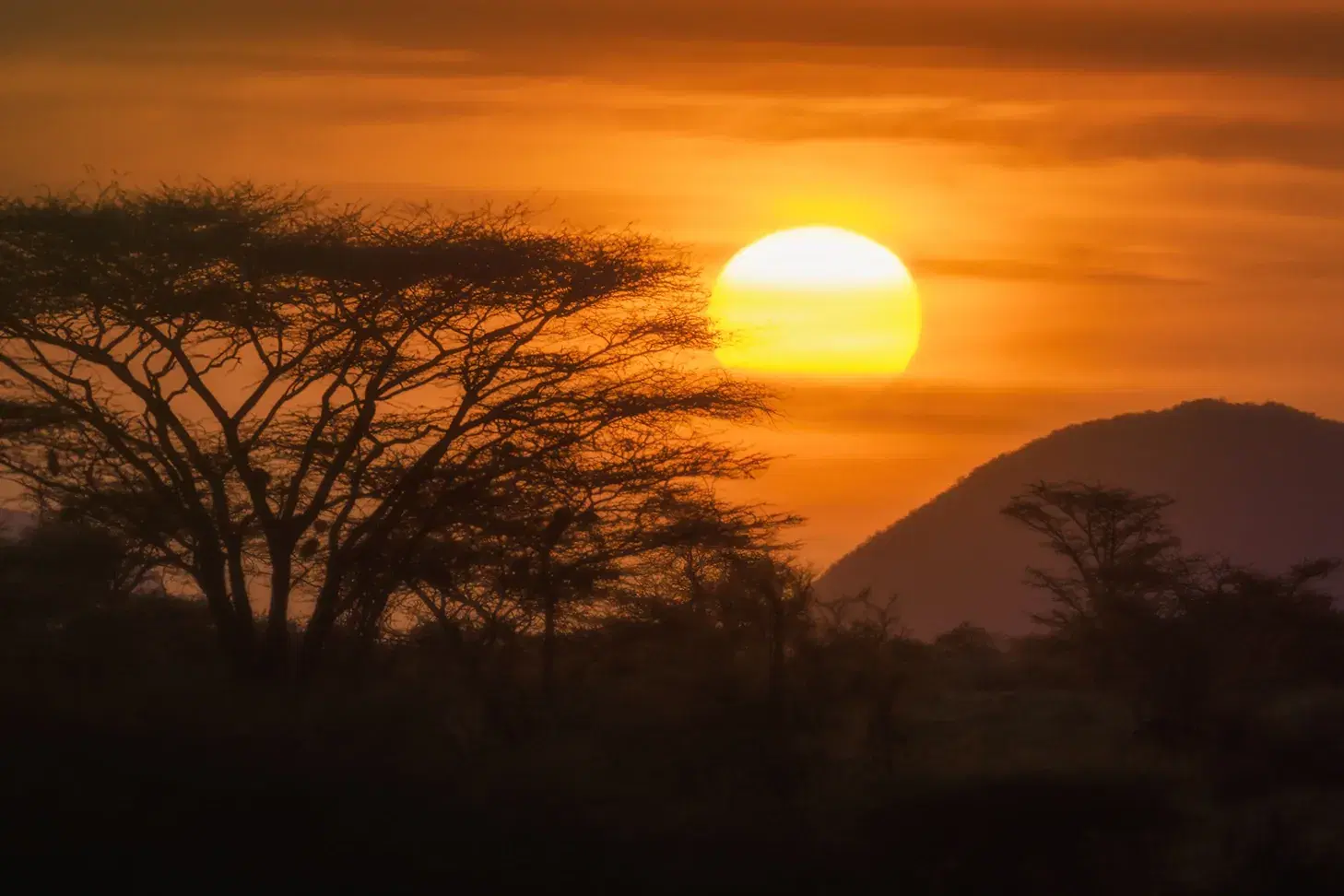
Sunset over the African savannah with an acacia silhouetted against the sun

Guide

Routes and stopovers from Santiago to East Africa, how long the journey takes, the time difference, baggage limits, documents and insurance for a safari.

There is no direct flight between Santiago and East Africa. The usual routes connect in Europe, in the Persian Gulf or in Addis Ababa, with one or two stopovers, and the full journey takes between twenty-four and thirty hours door to door in each direction. The time difference with Kenya, Tanzania and Uganda is six or seven hours depending on the date.

Santiago and Nairobi sit at almost opposite ends of the usual commercial network, and nothing flies between them directly. Every route passes through a third continent.

The connections that work in practice run along three corridors. The European one, crossing the Atlantic to Madrid, Paris or Amsterdam and dropping south from there. The Gulf one, via Doha or Dubai. And the African one, entering through Addis Ababa, which usually adds up to the fewest hours overall.

The number to keep in mind when planning is this: between twenty-four and thirty hours each way. Which means a seven-day safari on the ground becomes, in practice, a ten- to twelve-day trip from the moment you leave home until you are back.

The arrival airport sets the start of the itinerary, and it is not always the capital's:

Kenya — Nairobi (NBO)

Jomo Kenyatta International is the natural gateway to a Kenyan safari. Our itineraries begin there, with a meet at the airport and a private transfer, and they end at the same point.

Tanzania — Kilimanjaro (JRO)

This is the way into the northern circuit: Serengeti, Ngorongoro and Tarangire. Dar es Salaam serves the coast and Zanzibar, but it is a long way from the northern parks.

Uganda — Entebbe (EBB)

On the shore of Lake Victoria, a short distance from Kampala. Transfers towards Bwindi and the rest of the primate circuit start from there.

If the itinerary includes internal flights on light aircraft — routine for reaching the Mara or the Serengeti without a ten-hour drive — there is a restriction that catches a lot of people out: those charters usually cap baggage at around fifteen kilos per person, in a soft bag with no rigid frame.

A standard hard-shell case simply does not fit in the hold of a light aircraft. It is the kind of thing you want to know while packing in Santiago, not at check-in in Nairobi. When the itinerary calls for it, we tell you in advance and give you the operator's exact limit.

Kenya, Tanzania and Uganda share a time zone: UTC+3. That puts them six hours ahead of mainland Chile during our summer time and seven for the rest of the year. You travel east, which is the harder direction, but the gap is moderate and settles within a day.

It helps that a safari starts early by definition: getting up before dawn stops feeling like a sacrifice when the alternative is missing the best light and the busiest hour for wildlife.

The other factor is altitude. Nairobi sits at around eighteen hundred metres above sea level. That is not high enough to need acclimatisation, but it explains two things: the nights are cool, and the midday sun burns more than the thermometer suggests.

Entry and vaccination requirements change from country to country, from route to route, and sometimes without notice. That is why we do not publish a fixed list: we confirm it for your specific dates and your specific connections, and we walk you through the paperwork before you buy your tickets. It is one of the things we settle in the meetings before departure.

What is constant across the region is the demand for a passport with plenty of validity left — the general rule is six months from the date of entry — and with blank pages available for stamps and visas. It is worth checking as soon as the trip is agreed, because renewing a passport at the last minute is entirely avoidable.

On insurance: our packages do not include it, but we advise on taking it out. And there is one point we insist on checking, because not every policy carries it: medical evacuation cover. Inside a reserve there is no hospital around the corner, and that is exactly the cover you want to have bought and never use.

Kenya, Tanzania and Uganda each have their own shilling, but the US dollar is accepted as a matter of course across the tourist circuit. It is worth carrying some cash in good-condition notes — very old or damaged ones can be refused — for tips and small purchases.

Inside the reserves the signal for card payments is intermittent and should not be relied on. In the cities and the larger lodges it works without trouble.

The specific doubts we get most often on this subject, answered plainly.

Are there direct flights from Chile to Kenya?

No. No airline flies directly between Santiago and East Africa. Every route includes at least one stopover, usually in Europe, in the Persian Gulf or in Addis Ababa, and the full journey takes between twenty-four and thirty hours.

How many days do you need to set aside for a safari in total?

On top of the days on safari, allow around four for the journey out and back. A seven-day, six-night programme works out as a ten- to twelve-day trip counted from Santiago, and it is worth leaving a spare day in case a connection runs late.

What is the time difference between Chile and Kenya?

Six hours ahead during Chilean summer time and seven for the rest of the year. Kenya, Tanzania and Uganda are on UTC+3 and do not change their clocks.

Sunset over the African savannah with an acacia silhouetted against the sun and zebra behind

We design trips that adapt to your pace, your interests and the way you want to be there.